


The crevasse was cold. The stone pressed against Thrak’s body from every side, trapping the heat against the skin where the rock met the membrane. Outside, the predator’s footsteps traveled through the ground in a rhythm that was not the rhythm of wind or water. The rhythm of something that had a heartbeat and was searching for heartbeats that did not match its own.
Thrak pressed deeper into the gap. The body compressed without conscious command, the hydrostatic system responding to the vibration before the mind had finished processing the threat. The membrane drew tighter across the frame, the limbs pulled closer to the core, the overall volume reducing by a measure that would have been impossible if Thrak had been asked to do it deliberately. The body knew what to do. The body had known for generations.
The sound passed overhead. Thrak did not see the predator. The crevasse was too deep, and the world’s low light barely reached the opening, let alone the cramped space where Thrak had wedged into the stone. But The sound carried the shape of a dragging weight, a breath that rasped through airways built for a different atmosphere, the click of something hard against the rock above. The predator was close. Within a body-length of the crevasse’s opening. Stopped.
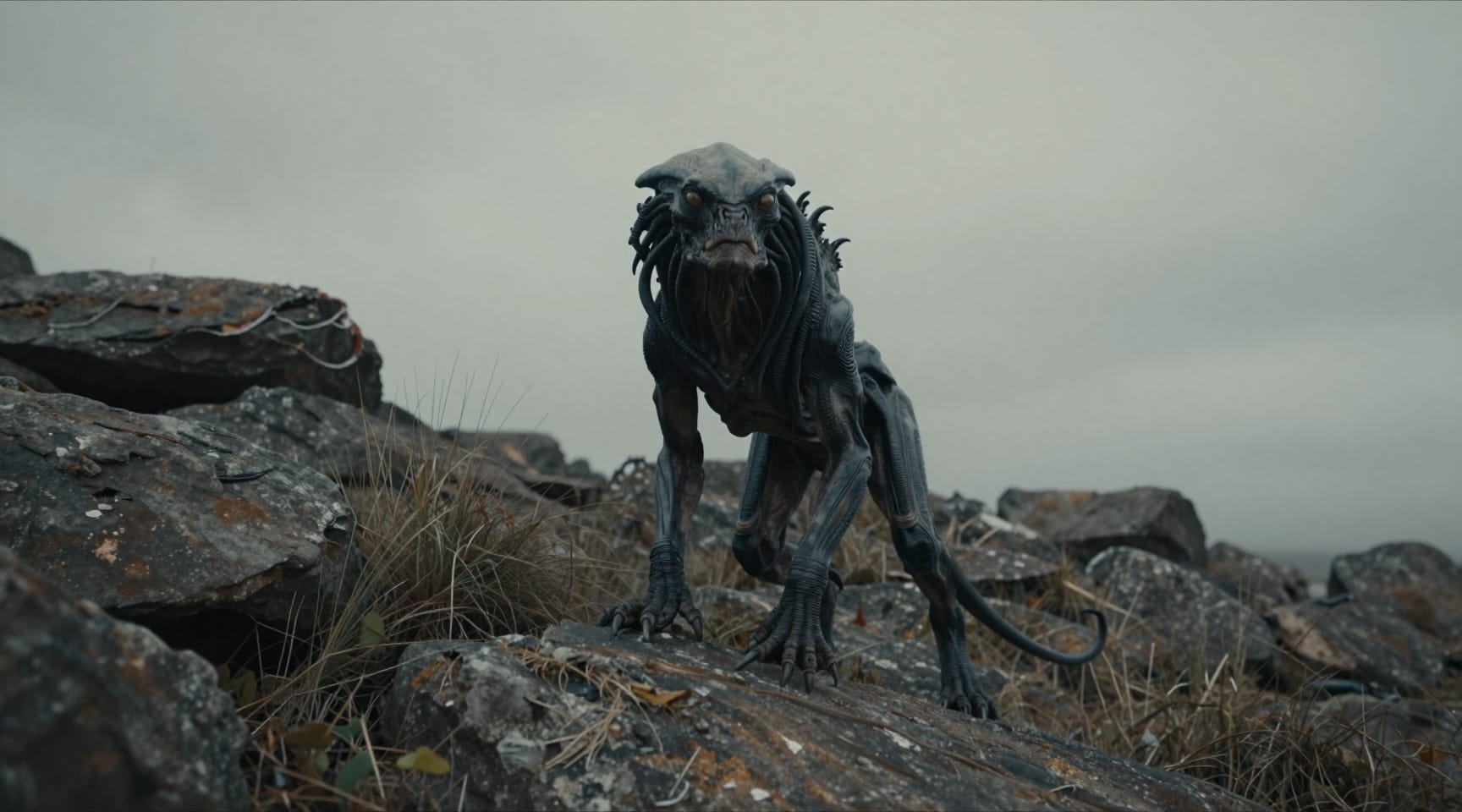
Thrak stopped breathing.
The pause stretched. The predator was listening. Not with ears Thrak could understand, but with something else, something that read the air for the chemical signature of fear, the thermal trace of a living body pressed against cold stone. Thrak’s body temperature was dropping where it touched the rock, equalizing. The hydrostatic compression had reduced the exposed surface area. The predator would have to be within reach. The predator was within reach.
Another long pause. The vibration traveled through the stone as the predator shifted its weight. Then the rhythm resumed, moving away, the footsteps growing fainter as the predator continued its hunt elsewhere.
Thrak did not move.
The body remained compressed. The breath stayed shallow. The mind stayed in the state it had entered when the first vibration registered: a silence deeper than thought, a waiting that was not patience but the suspension of everything that was not survival. Thrak had no word for this state. The language Thrak’s kind used had words for stone, for cold, for hunger, for the direction of the predator’s passage. It did not have a word for the thing that happened inside the body when the predator was close enough to kill.
The world’s rotation continued. The light changed at the crevasse opening, shifted from the gray of overcast to the deeper gray that meant the primary had passed beyond the ridge. Thrak counted the change by the temperature gradient on the exposed membrane, by the way the stone’s surface cooled in the shadow. One cycle. Two cycles. The predator did not return.
Thrak uncompressed.
The process was slow. The hydrostatic system released gradually, not all at once; the redistribution of volume was careful, measured, the body testing its space before occupying it fully. Thrak’s limbs extended, the membrane loosened, the core temperature rising as blood moved back into the extremities. The body was no longer hiding. The body was preparing to move.
Thrak emerged from the crevasse.
The world was the same as it had been before Thrak entered the stone. The same sky, a bruised gray that never fully brightened. The same terrain, broken stone and sparse vegetation that grew in the shelter of larger rocks. The same predator somewhere beyond the ridge, continuing its hunt for anything that breathed.
Thrak was not the same.
Something had shifted in the architecture of awareness. The experience of being pressed into the stone, of feeling the predator’s footsteps through the ground, of knowing that the predator would have found the crevasse if Thrak had not compressed small enough, quiet enough, cold enough, had changed the thing inside Thrak that was not the body. There was no word for this change. The language did not have a category for it. It sat there, a pressure at the base of the awareness, a commitment that had not existed before.
Thrak did not think about revenge. The concept required a framework Thrak did not possess. Thrak did not plan to fight. The predator was larger, faster, equipped with senses Thrak’s kind had not evolved. Thrak did not think about building weapons or organizing others or changing the balance of power on this world. Those thoughts belonged to a future Thrak could not imagine.
What Thrak carried was simpler and more permanent: the certainty that being hidden was not the same as being safe, and that Thrak would not spend another cycle pressed into the stone, hoping to be missed. Not because Thrak had a plan. Because the body had decided, in the moment of compression, that the predator would be the one to hide next time. The body did not know how this would happen. The direction had been set.
Thrak walked. The world was cold and gray and full of predators. But Thrak walked, and in the walking was something that had not been there before: the seed of a shape that would take fifty thousand years to grow into what it would become. The seed was not hunger. It was not ambition. It was the refusal to be prey, carried in a hydrostatic body that had learned to compress, walking across a world that did not yet know what it was nurturing.
The sky did not change. The predator did not appear. Thrak walked, and the seed grew, and the galaxy did not know it yet. But the galaxy would learn.
If you enjoyed this story, you can follow the main story arc in The Exodus Rush, the first book in The Vethrak Requiem series.