


Wanjiku Bett waited for the last tool to disappear behind the safe boundary before accepting the bay-clear signal.
A technician pulled himself along Slip Two’s access rail, carrying the lamp in a captive sleeve. His tether cleared the actuator guard. Beyond him, Article Four hung inside its proof cradle, a short gray barrel intended to join two pressure hulls somewhere Wanjiku would never be told. Three mixed-lot transitions crossed its curved structure. All three were finished. None had structural release.
She checked the camera against the clearance list. Torch locked away. Scaffold empty. Loose attachments restrained. The crane slings had gone slack after the cradle’s supports took the assembly; their straps were secured outside the moving fixture. The test forces would return through rock anchors, not through a crane or anyone’s boots.
“Boundary closed,” the operator said.
Wanjiku fastened her waist restraint inside the remote enclosure. A sealed slate bracket held the proof plan beside her display. Foreman Cho clipped into the adjacent station, close enough for her to make out the crease left by his cuff strap.
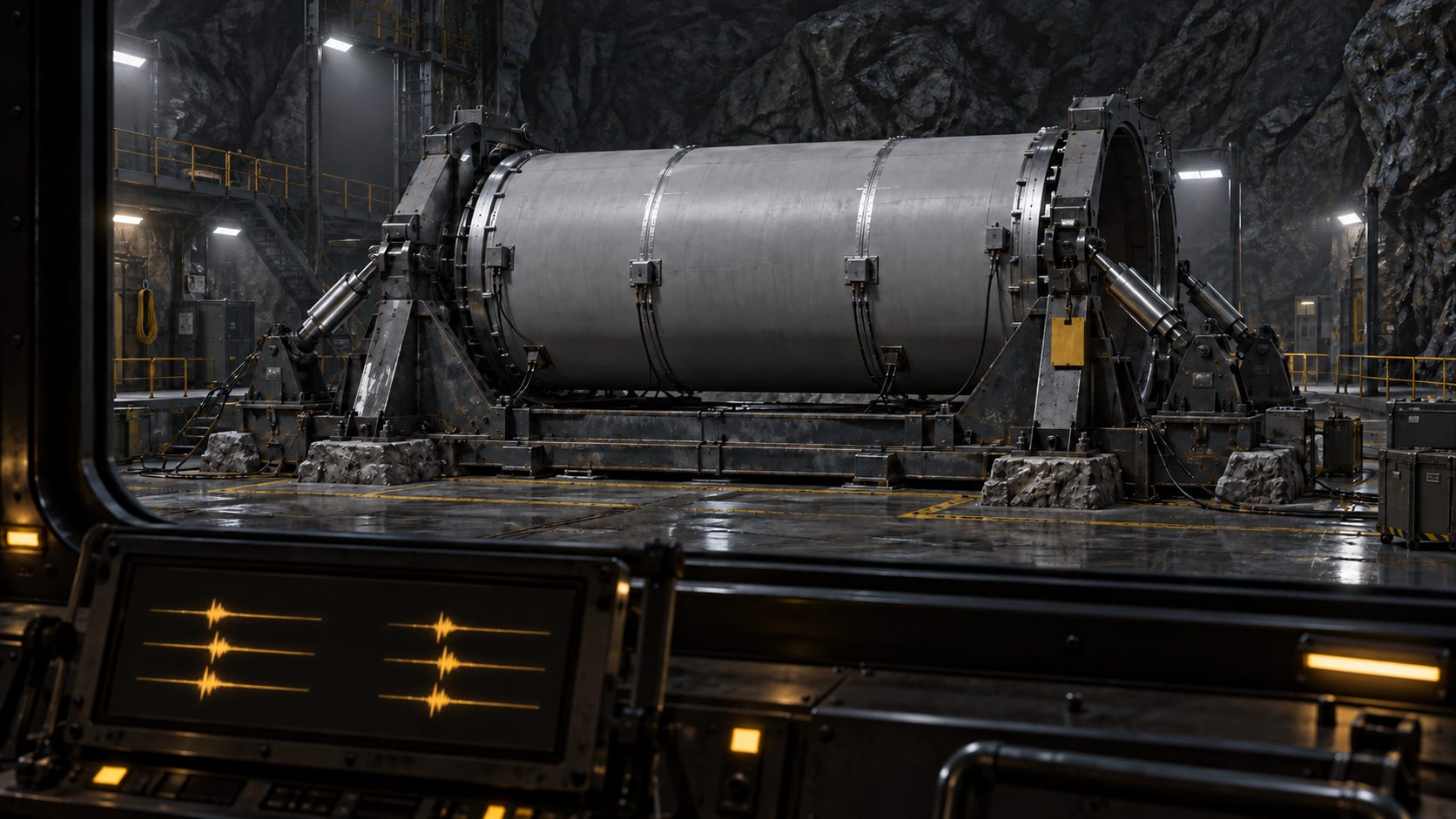
The structural-test tag showed amber in the camera view. Tuva Hawthorne’s signed attachment remained beneath it in the package: weld execution complete, all three transitions. Witnessed proof and materials disposition outstanding.
Wanjiku opened the pre-test ultrasonic scans. Their marked coverage followed each joint. No reportable indication. They established what the instruments had resolved before loading, not what the barrel would survive.
She left the baselines attached and opened the acoustic channels.
Before leaving the test bay, the technician had applied reference taps at the prescribed points on the fixture and barrel. Wanjiku replayed them against the channel map. Every pickup responded. Their arrival times agreed with the recorded positions. A tap on the fixture made its earliest mark on the fixture channel, then reached the barrel pickups in a distinct order.
She retained those traces without smoothing them.
Samrawit Assefa’s coupon records occupied a separate pane. One small event on the first mixed specimen during unloading. Nothing that established the same source on the second. The first pulse had stayed below rejection limits, too weak and too isolated to locate reliably.
Here, several pickups covered each of the three transitions. Strain gauges would record how much the metal stretched as the actuators pushed and bent it. Neither measurement could replace the other.
“Recording continuous?” Wanjiku asked.
“All channels. Raw timing retained.”
She checked the investigative threshold against the approved plan. It had been set before anyone knew what this barrel would say.
“First stage.”
The actuators took up force in measured increments. On camera, the barrel barely moved. Load entered through one interface and returned through the other, with the bending pair applying its prescribed offset. The scaffold supplied no reaction.
Strain rose along the expected curves. The acoustic panes stayed quiet beyond the known machinery background.
At the first target, the operator held.
Wanjiku compared the opposing gauges, then the displacement channels. No unexpected spread. The camera showed straight witness lines across the fixture connections and no opening at the weld faces.
“Hold complete,” the operator said.
“Controlled unload.”
The curves descended. Force reached zero, and the prescribed dwell passed without an unexplained event.
Cho released the edge of his slate bracket. “First stage accepted?”
“First stage recorded within limits. Advance to the second.”
He entered the milestone with her wording.
The second target demanded more axial force and a larger bending moment. Wanjiku kept the live curves beside their limits instead of enlarging the green completion field.
A cooling fan pressed a thin draft beneath her collar. Outside the enclosure, nobody approached the barrel. Tuva waited at the cleared access station with her gloves clipped to her harness.
The second-stage strain climbed and settled.
“Target reached.”
Every gauge remained inside its permitted envelope. Displacement stayed where the plan expected it. The close camera showed clean weld faces, unchanged edges, no buckle catching the task light.
The hold clock emptied.
“Unload,” Wanjiku said.
Force eased down under actuator control.
A cluster of acoustic arrivals filled the first transition’s channels. The next appeared at the second transition, then the third. Wanjiku’s fingers tightened against the console rim.
The fixture channel carried a weaker, later arrival.
She placed an event marker without interrupting the recording.
Farther down the same controlled ramp, another cluster crossed the pickups in the same order. First transition. Second. Third. Enough separation for the sequence to remain distinct; enough energy to put the event over her investigative threshold.
The operator’s hand stayed on the downramp control.
“Acoustic trigger,” he said. “Strain still inside.”
Wanjiku opened the reference beside the arrivals. The fixture taps had entered the channels differently. This pattern repeated across multiple pickups on all three transitions. She could follow its order without assigning a defect to it.
The coupon pulse had come as force left the specimen, too. That resemblance mattered. The coupon record still established no reliable source location.
Cho leaned toward his screen. “Can we complete the current stage?”
The next target waited below the descending curves. A third load would expose more of the barrel’s behavior. It would also put more force through whatever had answered twice.
She pictured the technician drawing a probe across the plate. There might still be something small enough to examine and repair. Loading it again could change what he found, and change how much of the barrel the yard could save.
“Continue controlled return to zero,” she said. “No third stage. Preserve every channel. Nobody touches the seams.”
“Return to zero. Third stage inhibited.”
The operator read back the command and canceled progression. He left the instruments powered.
Cho’s thumb stopped over the schedule pane.
“We haven’t reached the planned maximum.”
“Record that.”
He held her gaze for a moment, then entered the halt against the proof block.
Wanjiku kept her hand on the rim until the last force channel reached zero.
The zero-load dwell finished. The operator confirmed actuator isolation and the cradle’s continuing mechanical capture. The safe boundary remained closed.
No burst, no bent plate, no visible crack. Through the camera, Article Four looked ready for the next operation.
Wanjiku saved the complete record: load commands, strain, displacement, every acoustic channel, camera time, reference taps. She verified the stored copy against the live acquisition file before closing any pane. Quiet channels stayed beside active ones. The halt marker retained the force present when each cluster arrived.
Cho opened the outbound constraint. The window remained fixed.
“What can I send?” he asked.
“Proof halted before maximum. Repeatable acoustic sequence during second-stage unloading. Structural release withheld pending examination.”
He attached her signed disposition. Receipt from schedule control would not change it.
Tuva called from the access station. “Do you want the pickups moved for the scan?”
“Photograph their positions first. Keep the cables and attachments as they are until inspection records them.”
“Copy.”
Wanjiku entered the targeted ultrasonic examination against all three transition locations, with the retained pre-test scans required for comparison. Calibration first. No assumption about what the probe would find. The materials question stayed open beside the unfinished proof.
She pinned the two event groups to the location diagram. The same order remained in both. That was evidence she could carry forward, even while the inside of the plate stayed beyond her instruments’ present answer.
Beyond the enclosure, Article Four hung unchanged in its cradle.
Across the display, a line of sound moved through metal she could not yet see into.
Author’s note: This story continues the Site Anvil arc in late Year 3, during Article Four’s first full-scale proof test. The hidden yard builds ordinary human structure, and an unchanged surface cannot supply its inspection signature.
New to The Vethrak Requiem? Start with The Exodus Rush, Book 1, where humanity fights for survival after an alien invasion using technology it barely understands. These short stories explore the wider universe; the novel begins the main story.